
- مجمع عيادات شارع (9) - الهضبة العليا - المقطم - القاهرة
- +201099885538

In logistics and supply chain management, warehouse racks and industrial storage shelving serve as critical components for organizing inventory and optimizing floor space safely and efficiently. Designing storage layouts according to modern engineering standards maximizes vertical and horizontal spatial utilization in large industrial facilities, distribution hubs, and commercial centers alike.
Hydro Racks provides end-to-end engineering solutions for storage facilities. Through custom-built steel shelving systems engineered to support diverse weight capacities, Hydro Racks helps businesses improve storage density, accelerate inventory handling, and minimize product damage risks.
Storage configurations vary depending on product specs, weight distributions, and handling equipment. Hydro Racks supplies a complete range of engineered warehouse racks tailored for diverse industrial applications.
Pallet racking is the most widely adopted system in modern logistics. It enables goods stored on wooden or metal pallets to be accessed directly using forklifts, facilitating efficient inventory tracking and stock management.
Designed for high-density storage of homogeneous products, drive-in systems allow forklifts to drive directly into storage bays. This configuration significantly reduces aisle space requirements while maximizing cubic storage capacity.
Our website provides useful information about storage systems, warehouse organization, and space optimization, including storage solutions for different storage needs.
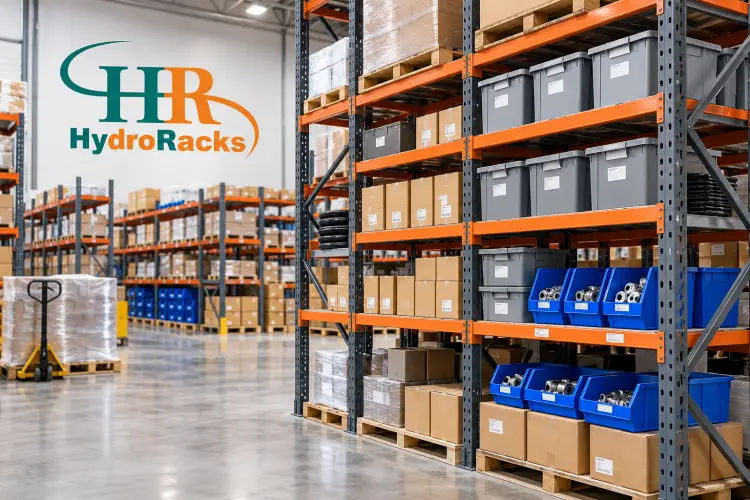
Cantilever warehouse racks are specifically engineered for storing bulky or elongated items, such as metal pipes, timber, and plastic extrusions. The open-front design eliminates vertical column obstructions, allowing smooth loading and unloading operations.
Mezzanine floor systems double available storage area without expanding the building footprint. By utilizing vertical height, structural steel platforms create additional operational levels without major civil alterations.
The table below highlights standard specifications across common storage setups:
|
Rack Category |
Dimensions (L × W × H) |
Max Load per Level |
Material |
Recommended Application |
|
Heavy Duty Warehouse Racks |
$180 \times 50 \times 200\text{ cm}$ |
$1000\text{ kg}$ |
Corrosion-resistant steel |
Factories & primary distribution centers |
|
Medium Duty Racks |
$180 \times 50 \times 200\text{ cm}$ |
$500\text{ kg}$ |
Galvanized steel |
Stockrooms & commercial stores |
|
Light Duty Racks |
$150 \times 40 \times 180\text{ cm}$ |
$150–250\text{ kg}$ |
Treated steel |
Archives, libraries & small storerooms |
The total investment required for warehouse racks depends on custom technical criteria:
Explore helpful guides about warehouse storage solutions, organization systems, and efficient space management, including steel storage rack for various applications.

To identify the most efficient layout for your operations, evaluate the following operational criteria:
Accurately sizing a layout requires systematically analyzing floor space, load dimensions, and handling machinery:
When evaluating types of racking system in warehouse setups versus specialized environments like IT infrastructure, technical standards vary significantly:
Discover reliable information about warehouse equipment, storage systems, and solutions designed to improve organization, including manual Clark for modern facilities.

Hydro Racks delivers complete storage engineering services focused on structural safety, spatial efficiency, and operational speed:
Hydro Racks follows a structured workflow to deliver compliant storage projects:
Pricing for warehouse racks in Egypt depends on load specs, material gauges, and layout scale. To obtain an accurate proposal, request a site inspection from a specialized storage system manufacturer.
Our engineering team at Hydro Racks will evaluate your site, analyze material flow requirements, and provide a detailed engineering layout and quote designed to maximize storage density within your budget.
Pricing is calculated based on system design (light, medium, or heavy-duty), load capacities per level, structural steel thickness, surface finishes (powder coated vs. galvanized), and total project size.
Selection depends on your product dimensions, weight per pallet, handling method (manual vs. forklift), and inventory turnover strategy (FIFO vs. LIFO). Consulting Hydro Racks ensures your layout aligns with NFPA safety standards and operational needs.