
- مجمع عيادات شارع (9) - الهضبة العليا - المقطم - القاهرة
- +201099885538

Modern storage solutions are no longer limited to basic steel shelving or traditional structures that clutter usable floor space. Today, industrial storage represents an integrated engineering strategy designed to optimize every square meter, transforming unutilized volume into tangible operational efficiency. Smartly designed systems drastically enhance workflow speed, reduce labor costs, accelerate cargo handling, and fortify supply chain reliability.
At Hydro Racks, we view a warehouse as far more than a passive repository for goods—it is a core engine driving operational productivity and commercial growth. Customizing structural layouts to meet exact facility requirements improves physical traffic flow, accelerates order assembly, and ensures long-term return on investment.
The ongoing shift toward advanced storage solutions reflects changing demands across industrial, manufacturing, and logistics sectors. Operations actively search for methods to maximize vertical space, accelerate order fulfillment, and eliminate unnecessary manual handling. Selecting an optimal layout is no longer just a capacity choice; it is a fundamental business decision directly impacting access speed, inventory management, and overall operating overhead.
|
Feature / Metric |
Static Storage Systems |
Dynamic Storage Solutions |
|
Operational Mechanism |
Fixed location per SKU; goods remain stationary until manually picked |
Shelves, racks, or goods move automatically based on demand and picking schedules |
|
Space Utilization |
Requires multiple dedicated aisles for forklifts and personnel |
Minimizes aisle footprint through mobile racking or Goods-to-Person (GTP) automation |
|
Inventory Control |
Relies on manual tracking and physical placement; interior SKUs can be hard to access |
Easily integrates with First-In, First-Out (FIFO) and automated inventory rotation protocols |
|
Retrieval Speed |
Personnel must travel long distances across the warehouse floor to retrieve items |
Items or rack modules travel directly to the picker, cutting travel time dramatically |
|
Capital & Flexibility |
Lower initial capital outlay; simple setup, but consumes larger physical footprints |
Higher initial capital investment; delivers major savings in floor space, labor, and time |
Learn more about racks for shop displays and the best solutions for improving storage and organizing available space.
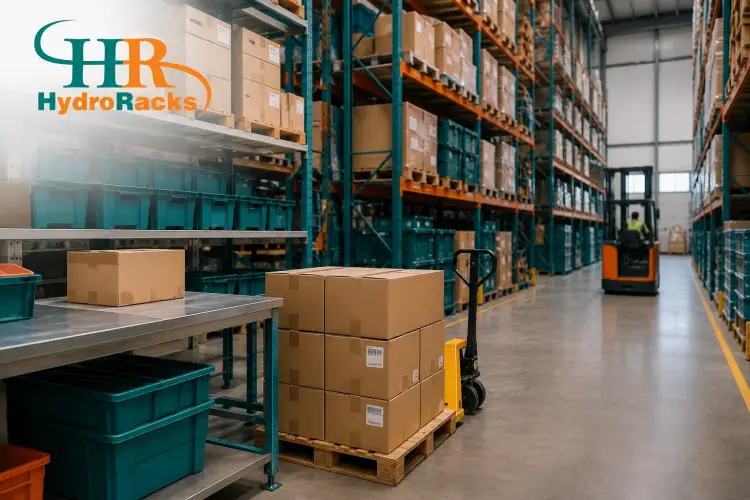

As dynamic storage solutions like mobile racking and vertical lift modules (VLMs) gain widespread adoption, integrated hydraulic technologies have become essential for driving high-density throughput. Major engineering benefits include:
Capitalizing on vertical building clearance allows facilities to scale storage capacity upward without expanding their physical footprint. By combining high-bay racking systems with specialized material handling equipment, businesses unlock massive volumetric storage.
Utilizing Very Narrow Aisle (VNA) reach trucks enables safe operation at high elevations while reducing aisle widths down to 1.5–1.8 meters. This structural approach adds extra pallet locations within the exact same physical footprint. Designing tailored shelving, optimized aisles, and matched handling equipment significantly boosts pallet density while bypassing costly real estate expansions.
Hydro Racks engineered products cover every level of industrial facility outfitting, spanning structural racks, heavy hydraulic equipment, loading dock systems, and integrated fire safety configurations.
We manufacture diverse structural configurations designed for varying load profiles while maximizing vertical clearances:
Our hydraulic machinery supports smooth lifting, loading, and internal transport across industrial facilities:
If you are looking for more information about metal racks for warehouse storage and effective ways to maximize storage space, read this article.
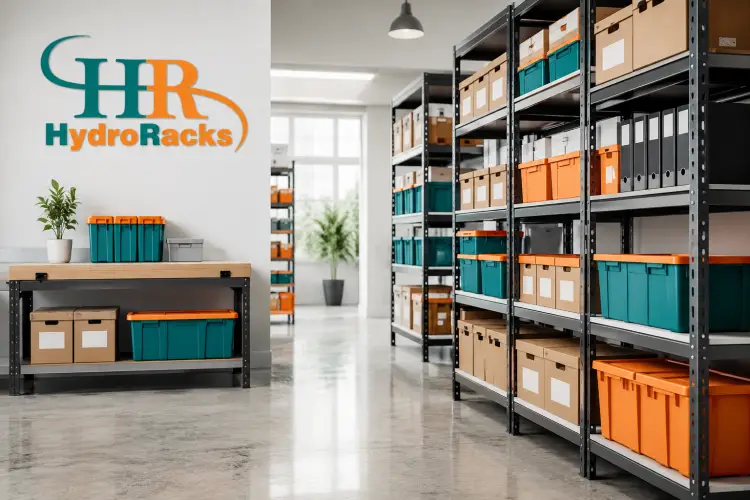

We manufacture specialized steel structures and facility equipment built to rigorous engineering standards:
If you are planning to upgrade your facility within the region, establishing modern Storage units egypt facilities demands high-spec engineering that accounts for localized floor loads, seismic ratings, and temperature factors.
Material handling speed is the primary indicator of a successful warehouse design. Practical efficiency is not measured solely by how many pallets fit onto high racks, but by how rapidly forklifts and operators complete picking, loading, and replenishment routines.
Smart warehousing represents a major leap forward in logistics performance by pairing structural mechanical strength with automated controls:
Implementing effective storage solutions begins with detailed engineering studies rather than off-the-shelf equipment purchasing. Site surveys must analyze load profiles, inventory turnover, slab load capacity, clear height, and forklift turning radii.
Purchasing standard equipment without professional site evaluation often leads to wasted space, structural overloads, or tight aisles that restrict forklift operation. Custom-engineered configurations guarantee that every racking upright, hydraulic dock, and structural beam is tailored directly to your operational workflow.
As a full-service leader in industrial infrastructure, Hydro Racks handles every phase of facility setup—from initial site measurement and floor load calculations to structural fabrication, equipment installation, and safety compliance audits.
Our site survey process includes:
Investing in engineered storage solutions delivers long-term returns by maximizing volumetric space, boosting daily productivity, and maintaining strict safety standards. Contact the engineering team at Hydro Racks today to schedule your comprehensive facility consultation.
Discover more about steel storage shelves and the key options that can help you improve storage organization and efficiency.
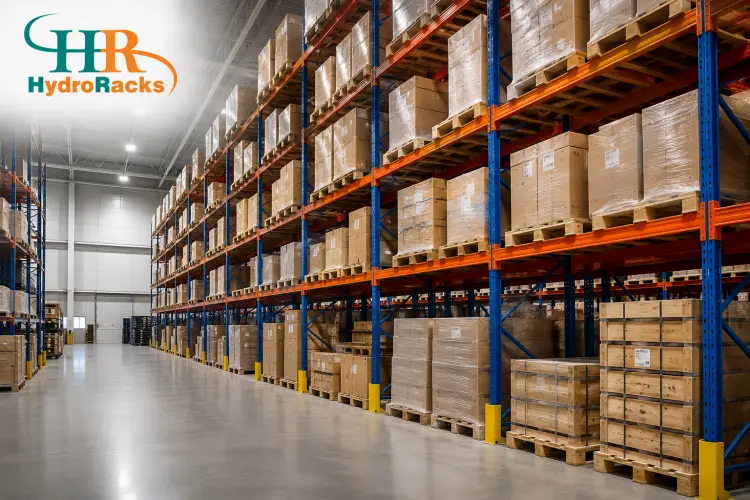

High-bay racking maximizes unused vertical height, while Very Narrow Aisle (VNA) systems compress aisle widths to 1.5–1.8 meters. Additionally, Drive-In and Pallet Shuttle systems allow deep-lane pallet stacking, eliminating inner aisles to maximize overall density.
Heavy palletized goods require heavy-duty structural pallet racks with high-capacity uprights. Small or loose items are best organized using hand-pick shelving supplemented by standardized Storage Box containers. Perishable goods require dynamic Flow Racking to maintain strict First-In, First-Out (FIFO) stock rotation, while long items like pipes or timber rely on Cantilever Racking.
Specialized firms like Hydro Racks deliver custom engineering, certified weight capacity calculations, integrated fire safety adherence, and seamless blending of racking with hydraulic handling equipment. This comprehensive approach maximizes warehouse capacity while protecting your workforce and lowering operating costs.