
- مجمع عيادات شارع (9) - الهضبة العليا - المقطم - القاهرة
- +201099885538

Fire suppression systems are essential for ensuring the safety of people and property and protecting them from fire damage. Their purpose is to detect fires quickly and extinguish them before they spread. These systems vary depending on the type of fire and the nature of the location, and include:
Each system is carefully selected based on the place of use and the type of potential fires, with the need for periodic maintenance to ensure optimal performance. There is usually an important question: Do fire extinguishing systems differ between companies and factories? And how is the number of fire extinguishers needed for each building determined?
In this article, we will answer these questions in detail, in cooperation with experts from Tayba Hydro Racks, which seeks to provide a safe environment and complete protection for individuals and property by providing the best fire extinguishing systems for each site, and sending specialized technicians to conduct a thorough inspection to determine the type of system and the number of extinguishers required, in addition to carrying out periodic maintenance to ensure the continued effectiveness of the protection.
When a fire occurs in hospitals, an emergency evacuation plan must be in place to ensure that staff and patients in the facility are protected from any danger, by providing the best way to evacuate them safely and as quickly as possible without panic attacks.
The clean media system (FM-200 & NOVEC) is considered one of the best fire suppression systems in hospitals, where it is installedIn areas with high rates of electrical firesStudies have shown that hospital fires are caused by electricity, and this system is non-conductive, thus helping to extinguish such fires.
A system for safety and fire protection must be followed in hospitals, especially during the initial construction phase:
Read more about : fire alarm monitoring company
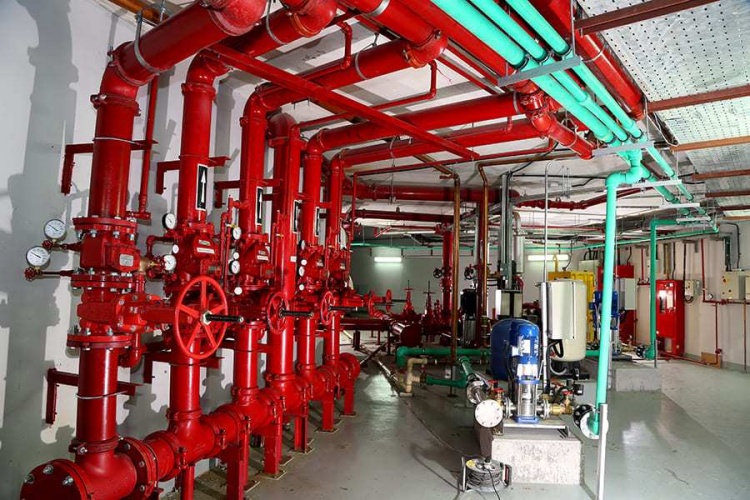
Fire suppression systems in buildings consist of two basic fire-fighting systems within buildings:
Alarm systems must be available in buildings, and they must undergo regular maintenance and continuous inspection.
The approximate lifespan of these devices ranges from 5 to 10 years.
Fire alarms alert people in the area to a fire, which most often occurs in homes, businesses, or public places. In addition, signals are sent to alert security personnel to the presence of a fire so that they can quickly intervene to extinguish it.
On another note, Tayba Hydro Racks offers other types of automatic fire suppression systems that activate as soon as fire or smoke appears. Fire alarms operate either manually or automatically, as they have become mandatory in businesses and buildings.
Alarm systems have many features that enhance the safety of the home or building and its inhabitants, including:
Fire extinguishing systems are an essential part of safety in buildings, factories and businesses, and are among the basic things that must be taken into account when building or equipping any new facility.
Fire extinguishing systems vary based on the specific needs of each building, depending on its size, area, and surrounding environment.There are many types of fire suppression systems:
These are equipment used to fight fires in their early stages. They are usually used by people present at the fire site. This equipment is divided into several types according to the extinguishing agent used, which requires knowledge of the types of fires and the order of each type. The instructions shown on each piece of equipment can be used to learn how to use it.
The foam system is an integrated installation in which concentrated foam is mixed with water in the foam mixing center to form the required foam, then it is transferred to risers from the foam production station, and exits through specific outlets to the area of danger that needs to be extinguished.
It is a fire suppression system that works to protect against fire automatically and manually, connected to a fixed pipe network for water supply, and uses special openings to spray a mist of water to absorb heat and replace oxygen, to reduce the temperature to control or extinguish the fire.
This system is characterized by not wasting large quantities of water compared to automatic sprinkler systems, in addition to the high quality in controlling fire suppression.
Carbon dioxide gas is non-conductive to electricity. It works to extinguish fires by blocking oxygen. This is done through several mechanisms, such as total automatic flooding. This system is implemented in areas devoid of people.
Clean gas is considered one of the main fire extinguishing agents, non-conductive, and evaporates quickly, removing deposits upon evaporation. It is broadly classified into two groups.
For example: nitrogen, argon, or a mixture of these gases.
Wet chemicals are used to extinguish fires to protect commercial kitchens from potential hazards, such as open flames, hot cooking surfaces, and areas containing large amounts of grease, which can cause oil and grease fires.
Read more about : fire fighting system installation
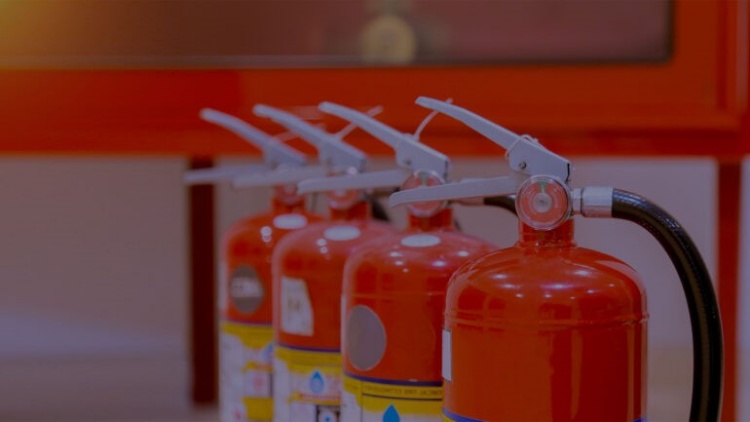
There are several differences between the FM200 system and the Novec system, and the differences between them in terms of features and method of operation can be explained as follows:
|
Comparison point |
FM200 |
Money |
|
Extinguishing method |
FM200 uses a halon substitute that evaporates quickly when exposed to heat, helping to extinguish the fire by cooling the source and reducing oxygen. |
Novec relies on an innovative fire extinguishing fluid that evaporates rapidly upon contact with air, absorbing heat and effectively cooling the fire. |
|
Environmental impact |
Less environmentally friendly than Novec, as it contains compounds that may affect the ozone layer. |
More environmentally friendly, leaves no harmful residue and does not affect the ozone layer. |
|
Effect of residues |
Some residue may be left after extinguishing, requiring additional cleaning efforts. |
It leaves no harmful residue, which makes the cleaning process easier after extinguishing. |
|
Protecting sensitive devices |
It provides good protection for sensitive devices, but requires caution due to potential residues. |
It offers excellent protection for sensitive equipment and devices without any damage, making it ideal for sensitive technical applications. |
|
Sustainability |
Effective, but less sustainable compared to Novec. |
More sustainable thanks to its safe formula and limited environmental impact, while providing effective protection. |
In short, while FM200 remains an effective choice for extinguishing fires, Novec offers greater environmental benefits and sustainability, along with superior protection for sensitive equipment without the need to worry about residues after extinguishing. Contact us now to learn more about fire extinguishing systems.
A water-based fire suppression system is a type of fire suppression system used to control and extinguish fires using water. This system is commonly used in large buildings, industrial, commercial, and residential facilities, where it is considered a fast and effective fire suppression system essential for fire protection. It is also known as a sprinkler system.
It is a system that automatically sprays water to combat and extinguish fires. Water comes out of the sprinkler heads to completely cover the fire site. It consists of a network of pipes that supply the heads with water according to their geometric diameters. These heads are installed close to the ceiling to allow water to flow and completely extinguish the fire. There is a system that supplies the heads with a sufficient flow rate and pressure to extinguish the fire according to the degree of danger to the building.
Recently, we have seen an increase in fire incidents in factories in industrial cities, where industrial facilities include many different industrial processes. These processes vary according to the characteristics of the raw materials, semi-finished and finished products, as well as the nature of those processes themselves.
The use of fire extinguishing systems varies depending on the size and type of each building, such as homes, businesses, and factories. The compressed air foam fire extinguishing system is considered one of the best systems that can be used in factories, especially in the case of leakage of flammable and combustible materials from equipment.
Among the main causes of fires in industrial sites that should be avoided are:
Some of the most important steps to follow when a fire is discovered are:
To handle the fire correctly and use appropriate fire suppression systems to control the fire and minimize losses, the following must be followed:
The use of fire suppression systems in factories has many important consequences that contribute to protecting lives and property and ensuring the continuity of production processes.
Read more about : fm 200 system design
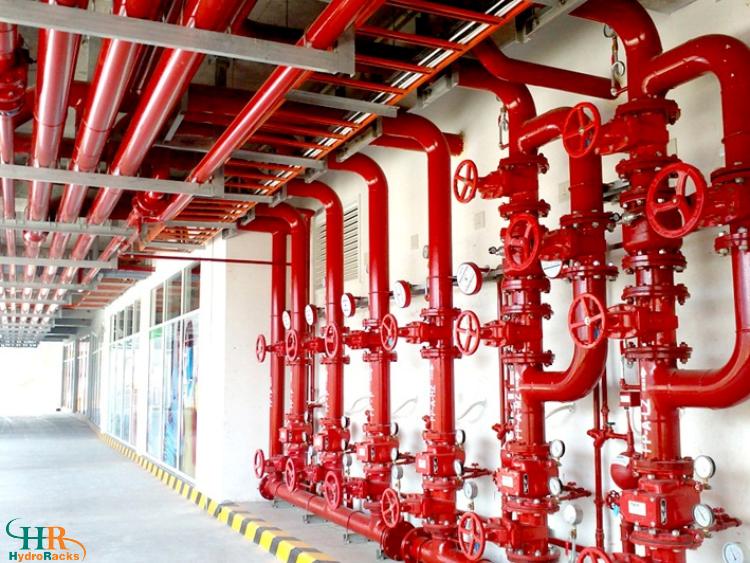
Generally, fire extinguishers are distributed in convenient locations no more than 20 meters apart, with one extinguisher per 200 square meters of area, or two extinguishers per floor. Firefighting equipment must be placed in easily accessible and visible locations for all site personnel. Civil defense connections must be provided, and clear signage explaining how to use fire extinguishers must be posted.
Tayba Company provides hydro racks All fire extinguishing systems, training workers on firefighting and how to use each system and giving them the necessary advice and instructions during a fire, where escape routes must be constantly checked and emergency lighting provided on each floor, and corridors, doors and stairs must be kept free of obstructions, and a sufficient number of emergency exits must be provided in each building under construction according to the number of workers in the building, with no less than two exits on each floor above the ground floor.
The system known as FM200 is a gas fire extinguishing system that uses HFC-227ea gas as an extinguishing agent. This system is used in cases of fires in areas containing vital or water-sensitive equipment.